 Add to Chrome
 Add to Firefox
 Add to Edge
SPIRAL: Symbolic LLM Planning via Grounded and Reflective Search
Dec 29, 2025
Large Language Models (LLMs) often falter at complex planning tasks that require exploration and self-correction, as their linear reasoning process struggles to recover from early mistakes. While search algorithms like Monte Carlo Tree Search (MCTS) can explore alternatives, they are often ineffective when guided by sparse rewards and fail to leverage the rich semantic capabilities of LLMs. We introduce SPIRAL (Symbolic LLM Planning via Grounded and Reflective Search), a novel framework that embeds a cognitive architecture of three specialized LLM agents into an MCTS loop. SPIRAL's key contribution is its integrated planning pipeline where a Planner proposes creative next steps, a Simulator grounds the search by predicting realistic outcomes, and a Critic provides dense reward signals through reflection. This synergy transforms MCTS from a brute-force search into a guided, self-correcting reasoning process. On the DailyLifeAPIs and HuggingFace datasets, SPIRAL consistently outperforms the default Chain-of-Thought planning method and other state-of-the-art agents. More importantly, it substantially surpasses other state-of-the-art agents; for example, SPIRAL achieves 83.6% overall accuracy on DailyLifeAPIs, an improvement of over 16 percentage points against the next-best search framework, while also demonstrating superior token efficiency. Our work demonstrates that structuring LLM reasoning as a guided, reflective, and grounded search process yields more robust and efficient autonomous planners. The source code, full appendices, and all experimental data are available for reproducibility at the official project repository.

TsSHAP: Robust model agnostic feature-based explainability for time series forecasting
Mar 22, 2023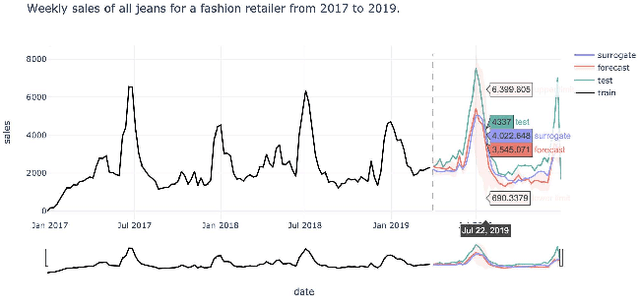
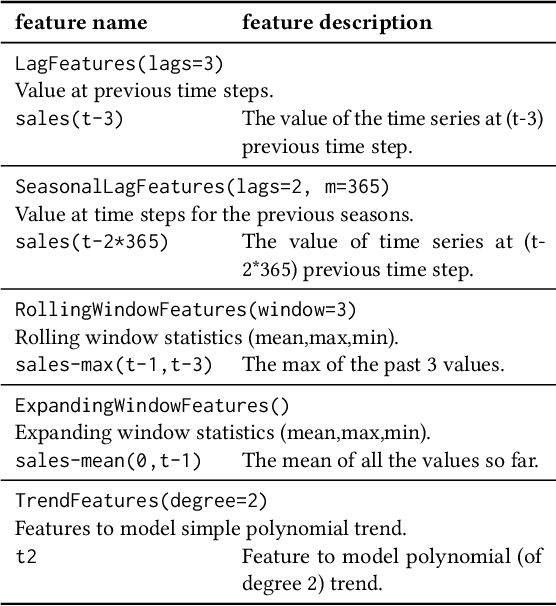
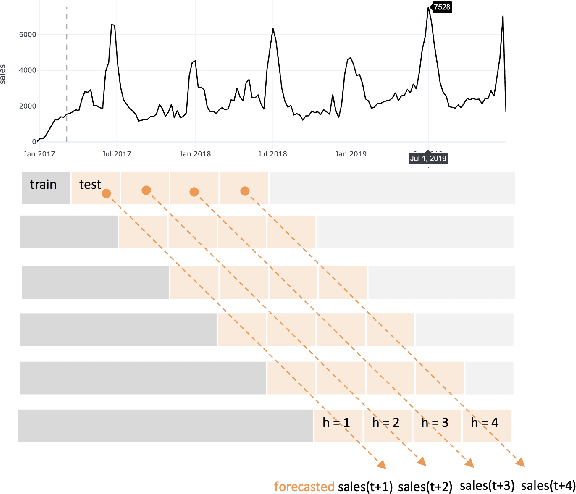
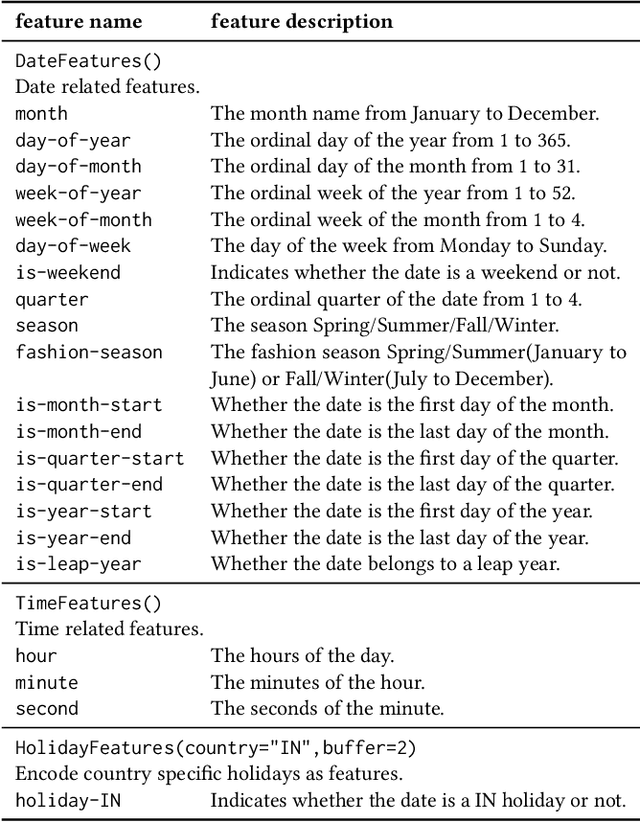
A trustworthy machine learning model should be accurate as well as explainable. Understanding why a model makes a certain decision defines the notion of explainability. While various flavors of explainability have been well-studied in supervised learning paradigms like classification and regression, literature on explainability for time series forecasting is relatively scarce. In this paper, we propose a feature-based explainability algorithm, TsSHAP, that can explain the forecast of any black-box forecasting model. The method is agnostic of the forecasting model and can provide explanations for a forecast in terms of interpretable features defined by the user a prior. The explanations are in terms of the SHAP values obtained by applying the TreeSHAP algorithm on a surrogate model that learns a mapping between the interpretable feature space and the forecast of the black-box model. Moreover, we formalize the notion of local, semi-local, and global explanations in the context of time series forecasting, which can be useful in several scenarios. We validate the efficacy and robustness of TsSHAP through extensive experiments on multiple datasets.
AutoAI-TS: AutoAI for Time Series Forecasting
Mar 08, 2021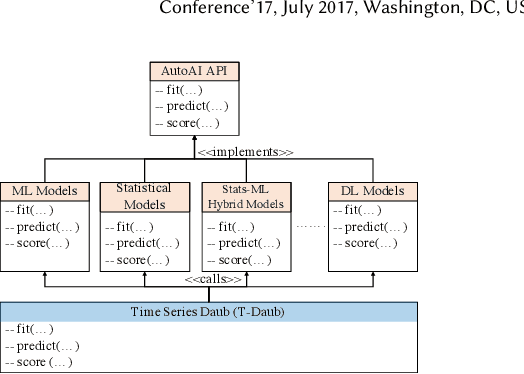
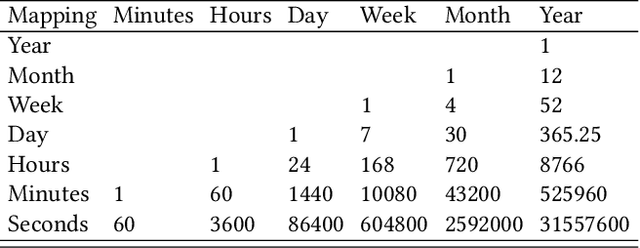
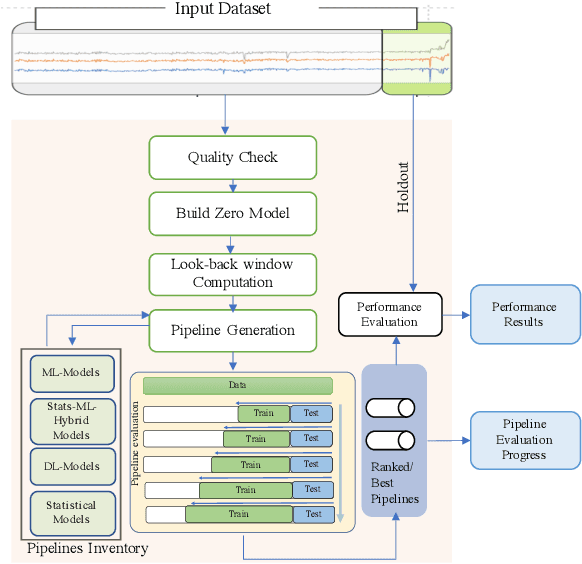
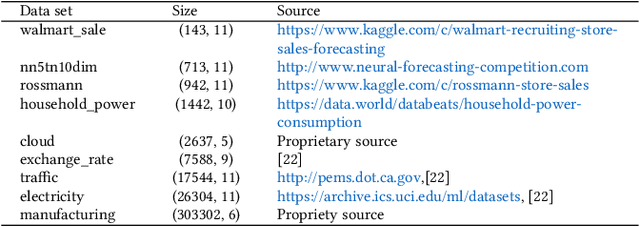
A large number of time series forecasting models including traditional statistical models, machine learning models and more recently deep learning have been proposed in the literature. However, choosing the right model along with good parameter values that performs well on a given data is still challenging. Automatically providing a good set of models to users for a given dataset saves both time and effort from using trial-and-error approaches with a wide variety of available models along with parameter optimization. We present AutoAI for Time Series Forecasting (AutoAI-TS) that provides users with a zero configuration (zero-conf ) system to efficiently train, optimize and choose best forecasting model among various classes of models for the given dataset. With its flexible zero-conf design, AutoAI-TS automatically performs all the data preparation, model creation, parameter optimization, training and model selection for users and provides a trained model that is ready to use. For given data, AutoAI-TS utilizes a wide variety of models including classical statistical models, Machine Learning (ML) models, statistical-ML hybrid models and deep learning models along with various transformations to create forecasting pipelines. It then evaluates and ranks pipelines using the proposed T-Daub mechanism to choose the best pipeline. The paper describe in detail all the technical aspects of AutoAI-TS along with extensive benchmarking on a variety of real world data sets for various use-cases. Benchmark results show that AutoAI-TS, with no manual configuration from the user, automatically trains and selects pipelines that on average outperform existing state-of-the-art time series forecasting toolkits.